

UPCOMING WORKSHOPS AND EVENTS
January 29, 2027 1:00 PM
Multi-institutional PD Opportunity
More Than Words: How to Think About Writing in the Age of AI
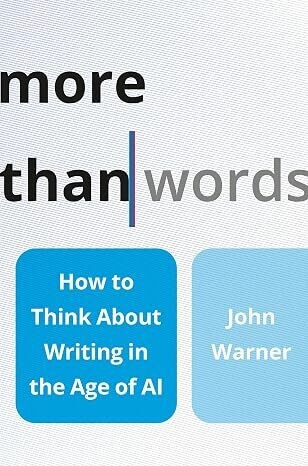 Author John Warner will give a combined talk and workshop where he will unpack the
real and present challenge of the presence of a homework machine (ChatGPT, et al.)
intersecting with a transactional system of education where grades and "achievement"
are often secondary to engagement and learning.
Neither students nor faculty are enthusiastic about outsourcing their work to automation, but the current system often incentivizes doing so. To create meaningful experiences and enduring and sustainable courses and institutions, we must focus on that which differentiates us from generative AI, our humanity and our capacity to learn through experiences.
In order to make space for our human selves we will consider the presence of generative AI in school contexts and understand what we must resist in order to value our humanity, what we must renew in order to develop our human selves, and then how we explore the intersection between humans and generative AI so as to teach and assess in ways that are open to new possibilities while preserving human-centered learning as the core of the educational mission.
The workshop will help faculty look at their disciplines and their teaching through the lens of building a "practice," the skills, attitudes, knowledge, and habits-of-mind that allow humans to be adaptable to change and preserve the autonomy and meaning of their labor. We will consider aspects of both assignment design and assessment approaches that will provide participants with a method for thinking through their unique teaching contexts and developing approaches that are consistent with their values.
There is no one-size-fits-all approach to teaching, particularly teaching in a world with generative AI, but the workshop will give a blueprint and path for any faculty to follow to work the ongoing process of making their work interesting and relevant to both themselves and their students.
Previous Events
Campus Update - AI Committee - Webinar
Update on everything the A.I. Committee has accomplished this fall and a look ahead to what is next.
Topics included...
- Official launch of the ATU AI Guiding Principles
- Updates regarding the Google Accelerate Program
- Practical tips for embedding AI in your courses
- Introduction to the ATU Human Advantage framework
- Invitation to the Grounds for Teaching events
- Open Question and Answer session
- What’s next?
Embracing AI as Essential Learning: Preparing Students for Life Beyond College - Keynote Address

Generative AI tools have had an astonishingly quick impact on the ways we learn, work, think, and create. While higher education’s initial response was to develop strategies to diminish AI’s influence in the classroom, it is now clear that AI competencies and literacies must be embraced as essential learning for most colleges and universities. These responses and realities create a challenging tension that higher education must work to resolve. Drawing from his new book, Teaching with AI: A Practical Guide to a New Era of Human Learning (second edition; Johns Hopkins University Press, 2025), Dr. C. Edward Watson will detail the challenges and opportunities that have emerged for higher education, especially in terms of pedagogical practice and student learning. The core focus of this keynote will be on concrete approaches and strategies higher education can adopt, both within the classroom and across larger curricular structures, to best prepare students for the life that awaits them after graduation. It will also detail the pedagogical possibilities regarding how AI can have a positive impact on student learning.
About the Presenter: C. Edward Watson, Ph.D., is the Vice President for Digital Innovation at the American Association of Colleges and Universities (AAC&U). He is also the founding director of AAC&U’s Institute on AI, Pedagogy, and the Curriculum. Prior to joining AAC&U, Dr. Watson was the Director of the Center for Teaching and Learning at the University of Georgia (UGA). He continues to serve as a Fellow in the Louise McBee Institute of Higher Education at UGA and recently stepped down after more than a decade as the Executive Editor of the International Journal of Teaching and Learning in Higher Education. His most recent publications are the second edition of Teaching with AI: A Practical Guide to a New Era of Human Learning (Johns Hopkins University Press, 2025), Leading Through Disruption: Higher Education Executives Assess AI’s Impacts on Teaching and Learning (AAC&U, 2025), and the Student Guide to AI (Elon University & AAC&U, 2025). Dr. Watson been quoted in the New York Times, Chronicle of Higher Education, Inside Higher Ed, Campus Technology, EdSurge, Newsweek, U.S. News, EdTech, Consumer Reports, UK Financial Times, and University Business Magazine and by the AP, CNN and NPR regarding current teaching and learning issues and trends in higher education. Described as a digital learning pioneer, Dr. Watson was recognized by EdTech Magazine as one of the top 25 higher education influencers to follow in 2026.on Bock is an instructional designer, learning engineer, and higher education leader. He currently serves as Director for Online Education at the Eberly College of Arts and Sciences at West Virginia University, where he leads online program strategy, faculty development, accessibility initiatives, and AI innovation. Jason completed his doctorate in Instructional Design and Technology at the University of West Florida He has developed practical AI solutions including an AI tutor for statistics, an AI-powered student support knowledge base, and a course on using AI on the job. He brings a creative, systems-oriented approach to complex institutional challenges. His work and research have focused on student AI use, AI-resistant assessment design, and helping faculty and students leverage generative AI as a tool for deeper learning rather than shortcutting it.
AI Policy on a Real Campus - Presentation at the National Conference of Academic Deans
ATU TECH TALKS - Mini Conference
Human in the Loop: AI Literacy Meets Information Literacy - Webinar

Students and faculty alike are asking: “Will AI replace us?” Shawna Thorup, Dean of Library and Academic Support Services at NorthWest Arkansas Community College, brings a hopeful answer: “No, not if we keep humans in the loop.” Building on her work teaching students ethical AI use and grounded in national AI literacy and information literacy frameworks, this session explores the powerful overlap between AI literacy and information literacy. Dean Thorup will demonstrate why human expertise, fact-checking, and critical evaluation aren't just nice-to-have skills; they're the irreplaceable core of AI literacy and workforce readiness. Faculty will leave with practical, discipline-agnostic strategies for designing assignments that position students as critical collaborators with AI, not passive consumers of it, ensuring our students enter the workforce as responsible, indispensable thinkers.
Embracing Generative AI to Reinforce Durable Skills - Webinar
 Join Dr. Jason Bock to explore some practical ways we can use the "worst tool for critical thinking"
to strengthen our students' critical thinking skills.
About the Presenter: Jason Bock is an instructional designer, learning engineer, and higher education leader. He currently serves as Director for Online Education at the Eberly College of Arts and Sciences at West Virginia University, where he leads online program strategy, faculty development, accessibility initiatives, and AI innovation. Jason completed his doctorate in Instructional Design and Technology at the University of West Florida He has developed practical AI solutions including an AI tutor for statistics, an AI-powered student support knowledge base, and a course on using AI on the job. He brings a creative, systems-oriented approach to complex institutional challenges. His work and research have focused on student AI use, AI-resistant assessment design, and helping faculty and students leverage generative AI as a tool for deeper learning rather than shortcutting it.
Please direct any comments, questions, or concerns to: ai@atu.edu